
Theodore Burr was born on August 16th, 1771 at Torringford in northwest Connecticut before migrating to Oxford, New York between 1792 and 1793. It was here at Oxford that he constructed a grist mill and water dam on the banks of the Chenango River. To accompany these projects and aid his growing business, Burr built his first bridge over the Chenango River in 1800. Ten years later, he would begin construction on his Federal style home that now houses the Theodore Burr Covered Bridge Resource Center and the Oxford Memorial Library in Fort Hill Square.
Soon after the construction of his first bridge, Burr began his career building and designing bridges across the Schoharie Creek and Mohawk River before moving to Pennsylvania. In 1804, he built the first bridge across the Hudson River between Lansingburgh and Waterford, New York that was uncovered with open arches. Unfortunately, the bridge failed by 1812 and was rebuilt in 1814-1815 using a different structure by Reuben Field, a collaborator on many of Burr’s bridges. It was this bridge erected by Reuben Field on the site of Burr’s original bridge that lasted until 1909 when it was lost to fire.
Among Burr’s most distinctive bridges during the first part of the nineteenth century were those at Trenton, NJ—Morrisville, PA, Schenectady–Scotia, NY, and Esperance, NY, none of which had a structure similar to what Burr later patented in 1817. Burr additionally constructed bridges that spanned the Susquehanna River in Pennsylvania, including at Harrisburg and Northumberland as well as one with a 360-foot span—the greatest ever attempted—at McCall’s Ferry, PA, and a multi-span bridge nearly 2,000 feet long between Rock Run and Port Deposit, Maryland.
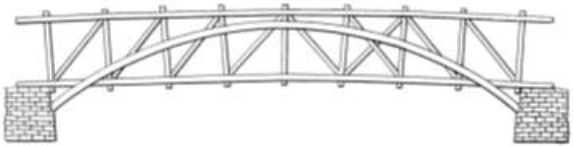
Many of these constructions did not rely on Burr’s 1817 patented arch-truss system design, which featured a multiple kingpost truss fastened with two spanning arches (shown below). The spanning arches are two curved pieces of lumber attached to the abutments at each end of the bridge, below the bridge deck. The arches and multiple kingpost truss work in tandem, simultaneously holding the weight on the bridge deck, and keeping the weight-lifting components of the bridge secure. The Burr arch-truss form came into widespread use after Burr’s death in more than 1,000 covered bridges in the United States and Canada. Many of the historic covered bridges still standing, including New York’s own Perrine’s Bridge found in Ulster County, display some form of Burr’s arch-truss.
Burr constructed and supervised many other notable bridges during his career, making him one of the premier engineers in early American history. However, of the more than 20 bridges he built during his life, none remain standing today. The only structure in existence designed and constructed by Theodore Burr himself is the house on Fort Hill Square, where the Theodore Burr Covered Bridge Resource Center is located.
Not much is known of Burr’s death, which reportedly occurred in November 1822 during the construction of a bridge across Swatara Creek, a tributary of the Susquehanna River in Pennsylvania. His burial site is also unknown. Additionally, there are no known images of Burr in existence, so his likeness too is a mystery. The Theodore Burr Covered Bridge Resource Center is dedicated to this hero of American history, whose works helped drive transportation and commerce in a rapidly growing economy.